Hawai’i Legislators Must Do More For Working Families

Working families deserve better. 

Hawai’i legislators routinely espouse platitudes about their desire to uplift our state’s most economically marginalized residents. For our most financially challenged neighbors, however, this year’s legislative session was a mixed bag at best. 

To their credit, lawmakers enacted tax relief that will boost the bank accounts of the islands’ lowest wage earners, including proposals to double the earned income tax credit, more than double the food/excise tax credit, and increase the child and dependent care credit. 

According to an analysis conducted by the Hawai’i Children’s Action Network, the vast majority of the intended $128 million in tax relief will benefit the state’s bottom two income quintiles, which include taxpayers earning less than $52,000 per year. 

Additionally, policymakers spent tens of millions of dollars on loans to low-income families for the installation of solar systems, devoted $60 million to increasing reimbursement rates for the Medicaid insurance plan that primarily covers low-income and disabled residents, dedicated over $38 million to expanding preschool access in underserved communities, and made meaningful, if not ambitious, investments in mental health and affordable housing.

Each of these measures will advance the economic well-being of local communities. Yet, when most households are besieged by Hawa’i’i’s perennially escalating cost of living and the government’s budget surplus was projected to exceed $2 billion to begin the year, legislators failed to seize the moment to deliver transformational change for the working class. 

Once again, elected officials did not seriously consider proposals to implement comprehensive paid sick and family leave programs. In Hawai’i, an estimated 42 percent of private sector workers lack paid sick leave, according to a 2015 analysis by the Institute for Women’s Policy Research, including only one in five low-income workers. 

Seven in ten children have both married parents or their lone single parent in the workforce, according to Hawai’i Children’s Action Network Speaks, leaving them without a full-time caregiver. Additionally, AARP Hawaii notes that there are nearly 157,000 unpaid caregivers helping our state’s aging population, representing about 40 percent of the local workforce. 

Paid sick and family leave programs ensure that employees can sustain their financial health when medical emergencies arise. Ultimately, those individual benefits enrich our entire society. Mothers with access to paid family leave, for example, are 39 percent less likely to receive public assistance after the birth of a child than those without access to the program, saving taxpayers money year after year. 

Political leaders also allowed important labor proposals to lapse, even when those measures carried no fiscal cost. House Bill 1087 would have closed a loophole in the state’s minimum wage law that allows businesses to avoid paying minimum wage increases by redesignating hourly workers as salaried employees. 

The measure received unanimous support from the Department of Labor, local unions, and economic justice advocates. Nonetheless, it drowned in the murky waters of the legislature’s conference committee process, despite the House and Senate agreeing to draft language during session that had no impact on state revenue. 

Finally, legislators missed an opportunity to adopt bold proposals to alleviate the adversity experienced by working families. With an unprecedented fiscal surplus at their disposal, policymakers could have tackled the price of paradise by expanding food programs for financially vulnerable residents, establishing a child tax credit, exempting unemployment insurance from the state income tax, and making community college free

Lawmakers have shown support for some of these ideas before. In 2021, the State Senate passed a proposal to eliminate the income tax on unemployment payments, largely to help the thousands of workers who lost their jobs during the pandemic. With the state’s unemployment rate currently hovering at just over 3 percent, this exemption would be significantly less costly to implement today, while still providing invaluable respite for families that are facing an unexpected disruption in their paychecks. 

We are just finishing the first year of the current legislative biennium. In 2024, legislative leaders will have an obligation to soothe the political turbulence that caused many of this year’s best policy ideas to capsize. For the sake of the hardworking women and men who form the heartbeat of Hawai’i’s economy, let’s hope they summon the courage to put people’s needs before political gamesmanship in the pursuit of prosperity for all. 

Schools Still Need Virus Vigilance

Safety first. 

As children, that motto was drilled into our minds. Whether we were crossing a street, learning how to ride a bicycle, or interacting with strangers, we were told to prioritize our personal security. If we behaved recklessly, then we knew that there might be consequences to our well-being.  

To improve public schools’ pandemic preparedness, Hawai’i Department of Education officials should remember those lessons. 

While our state continues to recover from the latest COVID-19 surge, we are learning more about the Delta variant’s impact on kids. During the summer, health experts reported that youth accounted for as many as 25 percent of total cases tabulated throughout the nation. A total of over 4,100 cumulative cases involving students and staff have been reported by the DOE since July 1, 2021. 

Though case counts are steadily dropping, concerns are still being raised by parents and educators about the capacity of schools to prevent potential outbreaks. Yet, Interim Superintendent Keith Hayashi continues to declare that the threat of campus-based transmission is minimal. 

It is time to put public safety before political convenience. Instead of repeatedly claiming that there is nothing for our schools to worry about, the DOE should take proactive steps to thwart future viral spread and strengthen public confidence in the department’s pandemic response. 

To begin, the interim superintendent should immediately engage in impact bargaining with the Hawai’i State Teachers Associations and other public sector unions to finalize a memorandum of understanding that covers COVID safety practices. At recent Board of Education meetings, teachers and community members have described numerous protocol violations, from mask mandates not being enforced to social distancing precautions being abandoned. 

HSTA and the DOE negotiated an agreement during the previous school year that established clear accountability procedures for enforcing safety guidelines. Updating that arrangement for the current year would ensure that breaches of health regulations are taken seriously when they are reported to school administrators. 

Additionally, the department should accelerate its “Operation Expanded Testing” program. Over 160 schools have signed up for the initiative, which expands screening to both students and school staff. Only approximately 60 schools had begun conducting tests as of September, however, in part due to supply shortages. Broadening access to testing is essential in diagnosing the extent of COVID transmission throughout Hawai’i’s public learning system, even as the state’s overall case count declines.

DOE leaders have hundreds of millions of dollars remaining from the department’s American Rescue Plan appropriation. In addition to plugging budget holes and boosting students’ social and emotional learning, the department should spend these funds on augmenting school-based COVID testing programs and amplifying distance learning opportunities for families that are concerned about campus safety risks. 

Finally, when the COVID vaccine is approved for 5-to-11-year-old children, the DOE should work closely with healthcare professionals to facilitate vaccination clinics on as many elementary school campuses as possible. Minors are still contracting the virus at elevated levels and can easily spread it to their neighbors, even if they are asymptomatic. Quickly vaccinating our keiki will prevent them from continuing to be sources of communal transmission, particularly in school districts with lagging vaccination rates. State leaders proclaim that this is their intent, but the program’s implementation must avoid the red tape and bureaucratic roadblocks that have impeded other COVID strategies.

Hawai’i appears to be turning a corner in its battle against the virulent Delta strain of the contagion. As we have repeatedly witnessed, though, the COVID virus is unpredictable. We cannot allow ourselves to be lulled into complacency by positive trends.  We must remain vigilant. And we must reinforce our public education system’s medical resilience, so that our schools are places at which knowledge spreads faster than the virus. 

So Much Left To Learn

Twenty years ago, American naïveté was hijacked.

Before the September 11, 2001 attacks on the World Trade Center and Pentagon, the United States thought of itself as impervious. Politicians believed that the fall of the USSR had resolved all grand ideological debates. Commentators predicted that democratic capitalism would consume the globe in short order. Even scholars talked about the “end of history,” which exalted “Western liberal democracy as the final form of human government.”

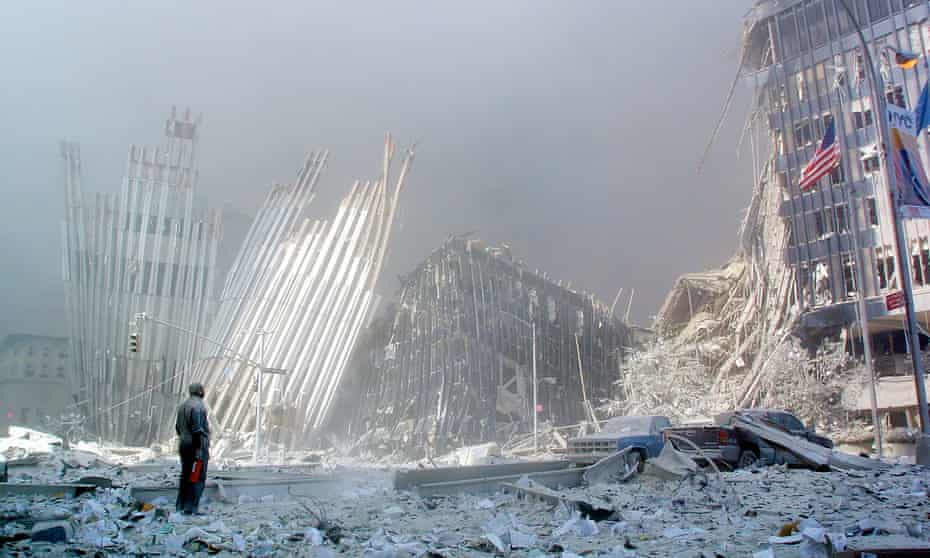
Any lingering devotion to the idea that the United States’ preferred forms of governmentality were ascendant came crashing to the ground on 9/11. Far from being perched near the apex of a neoliberal teleology, America found itself reeling from the sudden realization that its $700 billion per year’s worth of military might did not guarantee the nation’s eternal security.

As advertisements showcasing fun-loving families at McDonald’s were replaced with images of planes colliding with skyscrapers on our television screens, the U.S. was thrust into the realm of the uncanny, where the homogeneity of America’s national identity was suddenly destabilized. To borrow from the Bulgarian-French psychoanalytical philosopher Julia Kristeva, a “paradoxical community” began to emerge, “made up of foreigners who are reconciled with themselves to the extent that they recognize themselves as foreigners.”

Ruptures in the U.S.’s security imaginary should have prompted mass existential reflection about the exploitative foundations of America’s obsession with empire. Sadly and at great cost (both in lives and public funding), the nation instead doubled down on its imperial fantasy, with former President George W. Bush launching two wars in the Middle East while urging citizens to “get down to Disney World in Florida,” and “take your families and enjoy life, the way we want it to be enjoyed.”

“Don’t let the terrorists scare you away from Walmart,” we were told. Shopping uplifts the private marketplace, that most sacrosanct of American institutions and the architectural symbol of which had just violently collapsed. At no time was the connection between the pursuit of global economic domination and the turn-of-the-century American character called into question.

At no point were the consequences of organizing a society around the worldwide promotion of late stage capitalism reexamined. Though our country’s geopolitical grandiosity lay shattered at our feet, we never had a prolonged discussion about the need to forge new forms of solidarity, allyship, and community that are essential to empowering subjugated voices and advancing international unity.

Money was all that mattered. That was the American way.

Two decades later, the U.S.’s crisis response is still driven by greed. Approximately 41 million Americans have contracted COVID-19 since the coronavirus touched our shores, resulting in nearly 660,000 deaths. Entire swaths of the country, particularly in the southern states, are battling unprecedented case loads and hospitalization rates. Yesterday’s nationwide case count equaled 176,427 new infections, a number that is roughly 44 times higher than the total number of cases experienced by New Zealand during the entire pandemic.

Are we following the Kiwi policies of investing in a green economy, funding an arts recovery, and shuttering businesses to protect public health? No. Here, senators who are disproportionately empowered by Congress’s broken policymaking rules, like stalwart fossil fuel defender Sen. Joe Manchin, are undermining efforts to assist financially vulnerable families and address the climate crisis, no matter what the cost may be to people and the planet.

Pediatric cases are currently surging in the U.S., accounting for 25 percent of new infections. Yet, the possibility of schools returning to distance learning is slim because education systems are viewed as the country’s primary form of childcare for American workers. Even the Biden administration has called for in-person learning to continue, despite evidence that some large school districts, such as Hawai’i’s, are willfully violating federal safety guidelines.

We are literally sacrificing our children to boost corporate profits.

After 9/11, you would think that Americans would be more leery of human sacrifice. Many of us are, but too few of our leaders are listening. The situation is eerily similar to the days after the assault at Ground Zero, when the voices of those crying out for peace were muffled by those clamoring for vengeance. Hundreds of thousands of souls died in the combat that defined the aftermath of the fall of the Twin Towers, in wars that U.S. leaders are only today bringing to a close.

We still have time to rescue a commitment to communal empathy from our collective trauma. We still have a chance to thwart a worsening tragedy by putting human lives before dollar signs. If we steer our ship of state back toward the public interest, then in twenty years we will do more than memorialize a senseless loss of life. We will remember this era as a time when we pursued a politics of compassion like our lives depended on it.

Whether we have learned it yet or not, our lives, in fact, do.