
I Dream Of Objects

Two views. Pick one. Or none, if you disagree with both.

Dreams as affective manifestations: Virtually no one denies that dreams can be affective, productive of nonconscious phenomenological vectors capable of precipitating new patterns of thought and forms of relation. But are they fully embodied and substantive objects, things-in-themselves retaining their own autonomous and withdrawn inner being? According to Levi Bryant, the answer is no. For an entity to be deemed objectal, Bryant’s argument holds, its being must exist independent of all other entities. Full stop.

Since dreams are dependent upon the being of a dreamer, neurological impulses, semantic memories, neocortices, and the like, dreams cannot enter into, be extricated from, or form relations with other objects, and are, thus, reduced to the status of qualia, or ‘local manifestations’, an animation of qualities expressed by objects interacting within a specific and fragile spatiotemporal configuration, one that is broken upon the dissipation of the dream or the act of waking. From this view, dreams do not possess difference or becoming apart from the material difference effected by the entities from which it is drawn. And since, for Bryant, being is difference, dreams cannot be said to possess autonomous being, no matter how forceful their emotional residue may be.

Dreams as material objects: Claiming that dreams are nothing more than ‘local manifestations’ involves denying the mereology of dreams-in-themselves. If we grant that whole objects are existentially severable from and ontologically inexhaustible by their constituent parts, then we can say that dreams are quasi-imag(in)ed beings comprised of neurological and psychoemotive bits, made intelligible in the way that other mental manifestations, conscious or otherwise, are presenced and, for that matter, withdrawn. We get hung up on the putative immateriality of dreams, which appears to foreclose standard modes of sensory perception. Yet, at some level, dreams are ‘percevied’, inasmuch as they produce memories and corporeal effects–ever wake up shaking, following a powerful nightmare? Once we dismiss the correlationist circle–dreams exist for no other entity than the dreamer, who only has access to meta-cognized oneirological ideation–we’re left with the the possibility of dreams as agential beings, whose existence exceeds qualitative apprehension. Dreams cannot even be denounced as pure products of consciousness, in light of nonconscious biological factors involved in their fruition.

Borrowing from Ian Bogost‘s phenomenological interrogation of video game characters, we can ask the question: What is the real dream? Is it the dragon that chases me as I sleep? The electrical flow of information between the hippocampus and neocortex? Protoconscious processes that suppress the release of norepinephrine and serotonin? Sublated experience and neuroses? Perhaps the answer is, as Bogost would hold for Mario or Zelda, that all of these are the dream, meaning that all of these entities exist immanent to one another, such that no one entity is singled out as being more ‘real’ than its counterparts and relata. Like Zelda, the dream is real for each of its aforementioned components, leaving the sleeping dreamer as just one object among many toward which the dream gestures, distorts, and translates into its own terms. Dreampomorphizes, as Timothy Morton would say.

Your thoughts?
Faded Relations

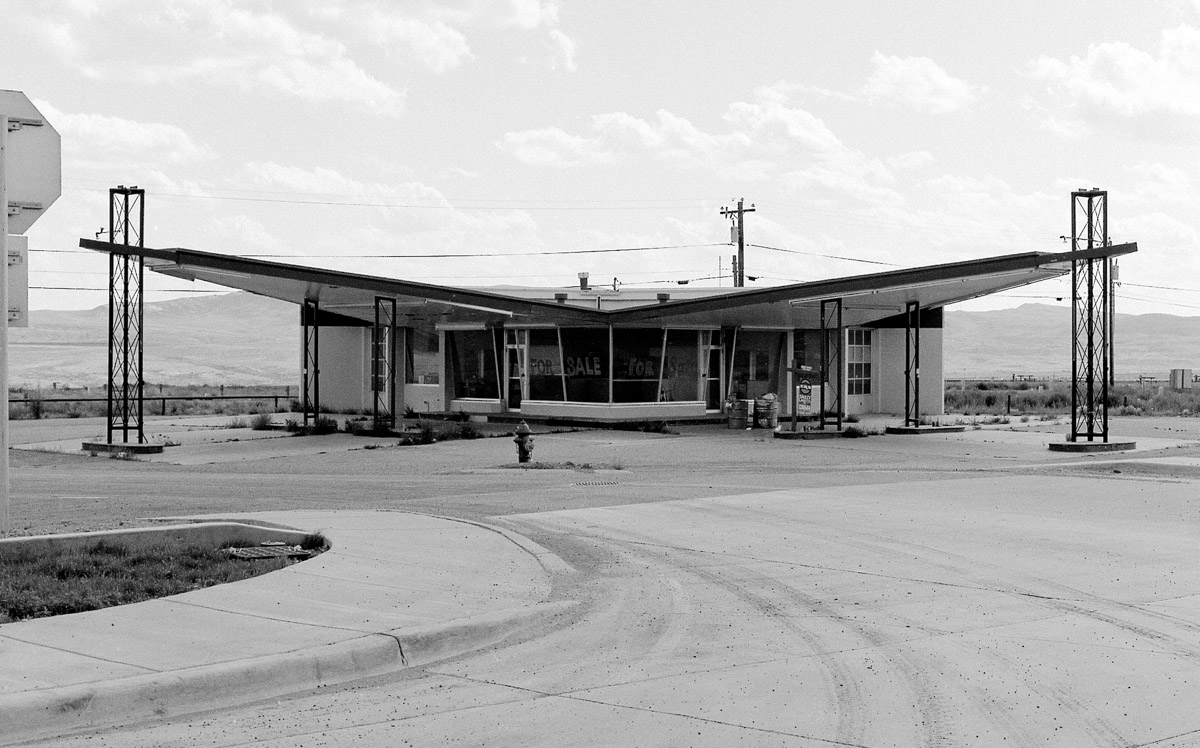
A fading swimming pool set amidst flourishing foliage. A fish-topped fountain, now inhaling musky air. A lone chair, overlooking a dried aquatic hotelscape. These are a few of the many objects contained in Jeff Brouws’ “Famoso Inn (with swimming pool),” in which the San Francisco photographer’s anthropological exploration of bleak aesthetics interrogates the origin, decay, and memorial space of industrial modernity.

Yet, the static moment musters not just collapsing markets, but caressing entities, each translating its enmeshed ecology into its own unique terms. Decay, capital, and bleakness are, themselves, implicated as conceptual objects in the frame, recorded as finite beings in a contingent material array. Here, we see a set of objectal powers unfurled before the human gaze, such as earth toned saturation and blue-hued siding soiled by brusquely textured debris. At the same time, we are exposed to the inadequacy of our own perception in representing the hyperpluralized being of Others, both human and nonhuman, that are constantly animating their own relational architectonics and spatiotemporality, encountering the sublime horror of uncertainty with each burst and retreat.

If this is an image of the deindustrialization in which Donald Trump’s ascension is so heavily ingrained, then it also an encounter with the uncanny core of automation: humanism is the remainder in need of elimination for capital to accelerate. There is no labor; there is only occupation. There is no wealth; there is only finance. There is no code instructing our capacity to resist; there is only the urgent call to resist as a mode of existence and with a fierce belief that an alternative politics is in desperate need of emancipation.

Becoming A Lyrebird

Lyrebirds are among Australia’s most famous native species, owing largely to an ability to mimic the natural and synthetic sounds of their habitat. Equipped with the most complexly muscled syrinx of any passerine, or songbird, the lyrebird’s call commonly includes the individual songs of other birds, along with less familiar sounds, like chainsaws, car alarms, camera shutters, barking dogs, and the human voice. What awes us about the bird is not simply mimicry, however, but the process by which it sheds its metaphorical plumage to become something foreign, concurrently rendering and recasting the surrounding soundscape with such fidelity that most animals sharing space with it are fooled. In this way, the lyrebird points toward the potential of rhizometry–the capacity the conceive our world(s) horizontally, rather than hierarchically–to undermine the essentialized origins and destinations of identity, unveiling becoming as a universal processual flow through which supposedly fixed and pre-given assemblages may be changed.

Consider, then, the implications of the lyrebird for an ecopolitics reduced to a struggle against ecclesiasticized capitalist modernity, as was evinced by Donald Trump’s assertion  about the Environmental Protection Agency during the 2016 presidential elected that, once elected, he was “going to get rid of it in almost every form. We’re going to have little tidbits left but we’re going to take a tremendous amount out.” (He’s well on his way to achieving that goal.) Rather than extol secular deconstruction over political ontotheology, the lyrebird croons about the relational expansion of potential into power when one becomes the other. As Deleuze and Guattari instruct:

A becoming is neither one nor two, nor the relation of the two; it is the in-between…a zone of proximity and indiscernability, a no-man’s land, a nonlocalizable relation sweeping up the two distant or contiguous points, carrying one into the proximity of the other–and border-proximity is indifferent to both contiguity and distance (Deleuze and Guattari, A Thousand Plateaus, 1987).

For the example cited above, a politics of becoming would carry environmental debates–from global climate change to the entrapment of nature-cultures within systems of biopolitical exploitation–into interstitial domains, where an intersubjective negotiation of identity can, like the fluid acoustic narrative of the lyrebird, enable coeval, but dissonant identities within pluralistic communities to carve space for a new political identities to be articulated. One thinks of the competing claims of protestors at Standing Rock, where privileged white entertainers mixed with abjected Native Americans–themselves a protestor population representing hundreds of tribes–to turn back the Dakota Access Pipeline under the appellation of “water protector.”

If all politics is identity politics–an idea we must take seriously in the Age of Trump–then we must also recall that subject positions, like borders, are nominal, not natural. Exploring our own capacity to become other than the positions we currently occupy will be mandatory in confronting the challenges of the long, hard Trump years to come.